If you’ve ever spent time with an Australian family or watched a local footy match on a Melbourne weekend, you might have found yourself nodding along politely while secretly wondering if everyone was speaking a different language. You aren’t wrong. The land down under is famous for its unique vernacular. We aren’t just talking about throwing a “shrimp on the barbie” (which, by the way, we call prawns). We are talking about the rich, humorous, and often bewildering world of Aussie Expressions.
To truly understand Australia from the bustling laneways of Melbourne to the sun-drenched beaches of the Gold Coast you need to understand the slang. These phrases are the glue of social bonding, the icebreakers at family barbecues, and the source of endless laughter during game nights. In this guide, we’ll dive deep into how to speak like a true Aussie, exploring the cultural context behind the words and showing you how families across the nation are keeping this linguistic tradition alive through play.
Why Aussie Expressions Are More Than Just Words
At first glance, shortening “afternoon” to “arvo” or calling a “servo” might seem like simple laziness. However, language experts and cultural anthropologists argue that Aussie Expressions reveal the core values of Australian culture: mateship, irreverence, and a deep-seated dislike for pretentiousness.
Australians use slang to break down barriers. In a corporate boardroom in Sydney or a casual pub in Fitzroy, using the right slang signals that you are a team player someone who doesn’t take themselves too seriously. It’s a verbal handshake that says, “We’re all mates here.”
The Role of Humor and Irony
Aussie humor is dry, self-deprecating, and often ironic. This is reflected heavily in the slang. For instance, if a surfer calls a massive, dangerous wave “a bit of a bump,” or if a tradie working in 40-degree heat says it’s “a bit fresh,” they are utilizing the classic Aussie understatement.
Learning these expressions isn’t just about memorizing a dictionary; it’s about adopting a mindset. It’s about learning to be resilient, friendly, and to always look for the joke in a tough situation.
A Deep Dive into Everyday Aussie Expressions
To help you navigate daily life, we’ve broken down the slang into categories that reflect how they are used in real-world scenarios. Whether you’re a new migrant, a traveler, or a local parent looking to teach the kids, these are the essentials.
1. Greetings and General Banter
The first thing you’ll notice is that formalities are often thrown out the window.
- G’day: The classic. While it is technically short for “Good day,” it is used at any hour. It’s casual and friendly.
- How ya goin’? : This isn’t usually a deep inquiry into your existential state. It’s the equivalent of “How are you?” The expected response is usually “Good, mate, you?”
- Yeah, nah: Perhaps the most confusing expression for outsiders. This is used to answer a question by disagreeing with the premise but agreeing with the sentiment. For example: “Are you coming to the footy?” “Yeah, nah, I’m stuck at work.” (Meaning: I understand the offer, but no).
- No wuckas: Short for “No wucking forries” (a play on “no fucking worries”). It means “No problem” or “It’s all good.”
2. The Art of the Abbreviation
Australians love to shorten words, usually adding an ‘o’ or ‘ie’ at the end.
- Arvo: Afternoon.
- Servo: Service station (gas station).
- Bottle-o: Bottle shop (liquor store).
- Tradie: Tradesperson (plumber, electrician, etc.).
- Brekkie: Breakfast.
- Maccas: McDonald’s. If you ask a local for directions, they will likely say, “Turn left at the Maccas.”
3. The Language of Family and Home
This is where Aussie Expressions become the fabric of family life. During a typical Melbourne winter weekend, a parent might yell to the kids:
“Oi, stop being a sook (crybaby) and put on your trackie dacks (tracksuit pants) before we head to the shops (supermarket).”
- Dacks: Short for trousers or pants. This is a crucial term, especially if you are playing games at home.
- Rellies / Rellos: Relatives. “We’re having the rellies over for Christmas lunch.”
- Mozzie: Mosquito. Essential for summer evenings.
- Esky: The portable cooler (cooler box) used for keeping drinks cold at the beach or a BBQ.
Learning Through Play: The Rise of Slang-Based Family Games
In an age where screens dominate our attention, Australian families are rediscovering the joy of analog entertainment. There is a growing trend toward board games that serve a dual purpose: entertainment and education. For multicultural families or younger generations who might be losing touch with traditional lingo, games centered around Aussie Expressions are becoming a household staple.
How do you teach a 10-year-old the difference between “chucking a sickie” (calling in sick when you aren’t) and “chucking a u-ey” (making a U-turn)? You can’t just give them a list. Language is learned through context, repetition, and—most importantly—fun.
The Social Bonding of Game Night
Imagine a Friday night in a suburban Melbourne home. The pizza has arrived, the drinks are on ice in the esky, and the family gathers around the dining table. Instead of turning on Netflix, they pull out a board game. The goal isn’t just to win; it’s to laugh. When someone confidently gives the wrong definition for “Durry” (cigarette) or tries to act out “He’s got a head like a dropped pie” (a humorous way to say someone isn’t attractive), the room erupts.
This is how language lives. By associating Aussie Expressions with positive emotions laughter, competition, and family bonding—the vocabulary sticks in the brain far more effectively than any textbook could manage.
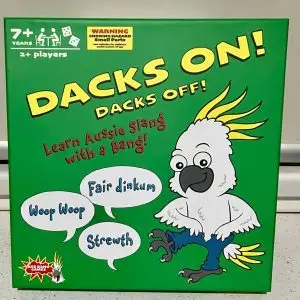
Games like Dacks On Dacks Off – The Aussie Slang Board Game tap directly into this cultural vein. They act as a bridge between generations. Grandparents can school the grandkids on authentic outback slang, while the younger generation can explain modern Gen Alpha terms. It turns a potential communication gap into a shared, joyful experience.
Melbourne: The Cultural Heartbeat of Slang
While Aussie Expressions are national, Melbourne adds a specific flavor. As the sporting and cultural capital, Melburnians have their own nuances. For instance, referring to the city as “Melbs” is a common local shorthand.
- Go the Pies: If you hear this, they are referring to the Collingwood Football Club, not dessert.
- The G: The Melbourne Cricket Ground (MCG), a sacred site for sports fans.
- Smoko: A break from work. In Melbourne’s famous laneways, you’ll see tradies grabbing their “smoko” coffee.
In Melbourne’s diverse suburbs, these expressions serve as a unifying factor. Whether you are in a high-rise in Southbank or a heritage home in Carlton, the slang cuts across socioeconomic lines. It is a reminder that in Australia, we are all “mates” regardless of background.
Educational Value: Why Schools Are Embracing Slang
There is a common misconception that slang is “bad English.” However, educators are increasingly recognizing the value of colloquial language in literacy development. For students learning English as a second language, understanding Aussie Expressions is crucial for social integration.
Building Cultural Literacy
A child who doesn’t understand what “fair dinkum” (genuine/true) means might feel left out on the playground. By incorporating slang into educational games, teachers can bridge the gap between formal academic English and the English spoken in the schoolyard.
Parents can support this at home by using games as a teaching tool. When a family sits down to play a game that requires matching slang to definitions, they are essentially creating a safe space for kids to ask questions. “Why do we call it a ‘barbie’?” becomes a gateway discussion about Australian history, summer culture, and the influence of American television versus local identity.
How to Incorporate Aussie Expressions Into Your Life
If you are ready to sound like a true local, you need to move beyond passive learning. Here are a few practical, actionable steps to integrate these phrases into your daily routine.
1. Start with the Family Dynamic
Change the vocabulary used in the household. Instead of saying “pajamas,” call them “jarmies.” Instead of “trousers,” say “dacks.” Kids are sponges; if you start using “arvo” and “brekkie” consistently, they will too.
2. Host a Themed Game Night
Invite the neighbors or the rellies over. Themed nights centered around Aussie culture are a huge hit. Make sure the main activity is interactive. Having a board game dedicated to slang ensures that the learning is active rather than passive. When you introduce a game like Dacks On Dacks Off, you aren’t just teaching words; you are facilitating an experience where everyone, from the teenager to the grandparent, is on equal footing.
3. Use It in Context
Never force a slang word; drop it in naturally. If you are at a cafe in Melbourne and the coffee is taking a while, you might say to your friend, “Looks like they’re flat out today.” If you’re driving and miss a turn, announce, “I’ll just chuck a u-ey.”
Modern Trends: The Evolution of Aussie Slang
Language is fluid. While the classic Aussie Expressions like “crikey” or “strewth” are fading into historical archives, new terms are emerging from the multicultural landscape and social media. Modern Aussie slang is heavily influenced by hip-hop culture, TikTok, and the diverse linguistic backgrounds of Sydney and Melbourne’s youth.
- Go off: To be angry or to party hard (context dependent).
- Shook: Shocked or surprised.
- Cozzie: Swimsuit (short for swimming costume).
However, the core of classic slang remains resilient because it is tied to specific cultural rituals—sporting events, the beach, and the backyard barbecue. These rituals aren’t going anywhere, and neither is the language that accompanies them.
Conclusion
Mastering Aussie Expressions is about more than just adding a few quirky words to your vocabulary. It is a passport to genuine connection. Whether you are standing at a sausage sizzle (fundraising barbecue) outside Bunnings Warehouse or sitting around a table with family in Melbourne, the ability to banter in the local tongue transforms you from a visitor into a participant.
The beauty of Australian slang lies in its ability to make us laugh, to include others, and to celebrate our unique identity. In a world that is becoming increasingly digital, the preservation of this language depends on social interaction. By bringing these words into our homes—through conversation, through storytelling, and most effectively, through family games—we ensure that the spirit of the Aussie vernacular lives on for generations.
So, next time you’re looking for a fun way to bring the family together, skip the screen. Grab a board game, crack open a cold one, and don’t forget to slip into your comfy dacks. You’ll be talking like a true local in no time.
Frequently Asked Questions
How do Australians use slang in daily conversations?
Australians use slang as a social lubricant. It’s used heavily in casual settings like pubs, barbecues, and sporting events to establish rapport. Rather than formal language, Australians prefer abbreviations (arvo, servo) and humorous phrases to keep conversations light-hearted and friendly.
Why is Australian slang so unique?
Australian slang is unique due to the nation’s history of isolation, convict roots, and the influence of Indigenous languages. It developed as a way for a diverse group of settlers to create a shared identity, distinct from British English, characterized by humor, resilience, and a tendency to shorten words.
How can people learn Aussie slang quickly?
The fastest way to learn Aussie slang is through immersion and active use. Watching Australian TV shows (Kath & Kim, Bluey) helps with listening, but the best method is social interaction. Participating in family game nights or using slang-based board games allows for repetitive, contextual learning that makes the words stick faster than memorizing lists.
Are slang games useful for learning Australian expressions?
Absolutely. Slang games are highly effective because they utilize gamification rewarding players for correct answers and encouraging social interaction. Games transform learning from a passive task into an active, competitive, and fun experience. This emotional engagement significantly improves memory retention and helps learners understand the context in which the slang is used.
What makes Australian slang fun for families and friends?
Australian slang is inherently humorous and visually descriptive. Phrases like “flat out like a lizard drinking” (very busy) or “up shit creek” (in trouble) are vivid and funny. When families play games involving these phrases, it creates shared laughter and often sparks storytelling about how these phrases came to be, strengthening family bonds.