Understanding Australian English goes beyond knowing grammar and vocabulary. If you’ve ever heard someone say, “Chuck your bag over here,” or “Let’s grab a snag at the barbie,” you’ve probably realised that everyday conversations in Australia are full of expressions that don’t appear in most English textbooks.
That’s where Games with Aussie slang make a real difference. Instead of memorising endless lists of unfamiliar words, you can learn through interactive challenges, role-playing, quizzes, and conversation-based activities that reflect how Australians actually communicate.
Whether you’re an international student in Melbourne, a traveller exploring Australia, or someone preparing to move Down Under, learning slang through games helps you understand local culture while building confidence in speaking naturally.
Melbourne, in particular, is a fantastic place to practise Australian English. From ordering coffee at a laneway café to chatting with classmates at university or cheering on your favourite AFL team, you’ll hear colourful expressions every day. The more familiar you become with these phrases, the easier it is to connect with locals and enjoy authentic conversations.
In this guide, you’ll discover why game-based learning works so well, explore engaging Aussie slang game ideas, and learn practical ways to Learn Australian slang that you can use in real life.
Why Australian Slang Is Hard to Learn
Australian English is often described as friendly, informal, and full of personality. While standard English provides the foundation, everyday conversations include shortened words, nicknames, playful expressions, and phrases that can leave newcomers feeling confused.
For example, someone might ask if you’re “keen” for lunch, tell you to “bring your thongs,” or suggest meeting “this arvo.” None of these phrases are difficult once you understand them, but they rarely appear in traditional language courses.
Unlike grammar rules, slang changes depending on context, age groups, and location. Melbourne locals may use certain expressions more frequently than people living in regional Australia, while workplace conversations often sound different from chats between university students.
Learning slang also requires understanding tone. Australians often communicate with humour and understatement. A phrase that sounds casual between friends may not be appropriate during a job interview or professional meeting.
Simply reading a dictionary of slang words isn’t enough. You need repeated exposure, practical examples, and opportunities to use new vocabulary in realistic situations. That’s exactly why interactive learning has become one of the most effective ways to build confidence.
Textbook English vs Real Australian English
Traditional English courses focus on sentence structure, grammar, and formal vocabulary. While these skills are essential, they don’t always prepare learners for everyday conversations.
Imagine learning English entirely from textbooks and then hearing someone say:
“No worries, mate. I’ll catch you later.”
Every individual word may be familiar, but the meaning, tone, and cultural context are quite different from formal English. Real Australian English relies heavily on shared cultural understanding. Speakers shorten words, use humour, and often expect listeners to understand expressions based on context. Game-based learning bridges this gap by introducing slang through conversations rather than isolated vocabulary lists.
Why Melbourne Is One of the Best Places to Learn
Melbourne is home to one of Australia’s most diverse communities, making it an excellent city for practising English every day.
International students, migrants, and travellers regularly interact with Australians in cafés, universities, sporting events, markets, and workplaces. These everyday experiences naturally expose learners to local language.
You’ll hear expressions while:
- Ordering coffee at a neighbourhood café
- Riding the tram
- Watching AFL with friends
- Shopping at local markets
- Joining university clubs
- Attending community events
The more situations you experience, the easier it becomes to recognise common phrases and respond confidently.
Combining these real-world opportunities with Games with Aussie slang creates a practical and enjoyable way to improve your Australian English much faster than memorisation alone.
Why Games with Aussie Slang Work Better Than Memorising Lists
Many learners start by searching online for “100 Australian slang words.” While vocabulary lists can introduce useful expressions, they rarely help people remember when and how to use them.
Games take a completely different approach.
Instead of passively reading definitions, you’re actively solving problems, making decisions, and connecting words with real situations. This process strengthens memory and improves long-term recall.
Learning Through Context
Imagine reading this definition:
“Servo = petrol station.”
Now imagine playing a game where someone says:
“We’re almost out of fuel. Better stop at the servo before heading home.”
The second example creates context. Your brain associates the slang with a realistic situation rather than a simple definition. This contextual learning makes new vocabulary easier to remember because it mirrors real conversations.
Better Memory Retention
Educational research consistently shows that active participation improves learning outcomes.
Games encourage learners to:
- recall information instead of rereading it
- solve challenges
- recognise patterns
- make quick decisions
- repeat vocabulary naturally
Each successful interaction reinforces memory without making learning feel repetitive. Rather than forcing yourself to memorise dozens of expressions at once, you encounter them multiple times across different activities.
Increased Speaking Confidence
One of the biggest challenges for English learners isn’t understanding slang, It’s feeling confident enough to use it. Interactive activities provide a low-pressure environment where mistakes become part of the learning process. Whether you’re competing with classmates, practising with friends, or completing online challenges, every conversation builds familiarity with Australian expressions. Eventually, using slang feels natural rather than intimidating.
15 Fun Games with Aussie Slang to Improve Your Australian English
Here are some engaging activities that help learners understand slang while enjoying the learning process.
1. Guess the Meaning
One player reads an Australian slang word while everyone else guesses its meaning.
For example:
- “Arvo”
- “Snag”
- “Brekkie”
- “Mozzie”
After everyone votes, reveal the correct answer and use the word in a short conversation.
This simple game builds vocabulary quickly while encouraging discussion.
2. Slang Bingo
Create bingo cards filled with common Australian expressions instead of numbers. As someone reads definitions or example sentences, players mark the matching slang. This activity is especially popular in classrooms because it combines listening, recognition, and friendly competition.
3. Conversation Challenge
Players receive conversation prompts such as:
- Ordering coffee
- Meeting classmates
- Going camping
- Watching football
Their goal is to naturally include three or four Australian slang terms during the conversation.
The winner is the player who sounds the most natural rather than the one who uses the most slang.
4. Match the Phrase
Write slang expressions on one set of cards and their meanings on another. Players race to match them correctly. Adding example sentences makes the activity more challenging while reinforcing context.
5. Café Roleplay
Australia’s café culture provides endless opportunities for language practice. One player becomes the customer while another acts as the barista. Encourage learners to include expressions commonly heard in Melbourne cafés during the conversation. This activity combines listening, speaking, and cultural understanding in a practical setting.
6. Aussie Charades
Instead of acting out movie titles, players act out Australian slang expressions.
For example:
- chuck it
- flat out
- knackered
- heaps
The rest of the group guesses the correct phrase before time runs out.
This physical activity is particularly effective because movement helps strengthen memory.
7. Emoji Slang Challenge
Create a series of emoji combinations representing Australian slang.
Example:
🌭🔥🍴
Players guess:
“Let’s cook some snags on the barbie.”
Visual learning adds another layer of memory, making expressions easier to recognise later.
8. Melbourne Street Challenge
While exploring Melbourne, learners photograph signs, menus, advertisements, or conversations containing Australian expressions.
Later, everyone explains:
- what they found
- what the expression means
- where it was used
- whether it sounded formal or casual
This transforms everyday experiences into valuable language lessons.
9. Aussie Slang Story Builder
Storytelling is one of the best ways to reinforce new vocabulary. In this game, each player adds one sentence to a story while naturally including an Australian slang expression.
For example:
“Yesterday arvo, my mate and I grabbed some brekkie before heading to the footy.”
The next player continues the story with another slang term. The goal isn’t to use as many expressions as possible, but to make the story sound like a real conversation. This activity helps learners think in Australian English rather than translating word by word.
10. Speed Slang Round
Set a timer for one minute and challenge players to explain as many Australian slang terms as they can without saying the actual word.
For example:
- “It’s another word for afternoon.” (Answer: arvo)
- “It’s where you buy petrol.” (Answer: servo)
The fast pace keeps the activity fun while encouraging quick recall.
11. Slang Flashcard Duel
Create flashcards with Australian slang on one side and the meaning on the other. Players take turns answering correctly to keep the card. At the end of the game, the player with the most cards wins. Digital flashcards work equally well and make it easy to practise for just a few minutes each day.
12. Aussie Trivia Night
Combine Australian culture with language learning by creating trivia questions about sport, food, landmarks, and everyday life.
Example questions include:
- What does brekkie mean?
- What is a barbie?
- Which city is famous for its laneway cafés?
- What does someone mean when they say they’re flat out?
Mixing culture with vocabulary helps learners understand not just the language but also the situations in which it is used.
13. Slang Detective
Watch a short Australian TV clip, interview, podcast, or video and listen carefully for slang expressions.
Write down every unfamiliar word, then discuss:
- What does it probably mean?
- What clues helped you?
- Was it used casually or formally?
This exercise develops listening skills and prepares learners for authentic conversations.
14. Listening Challenge
One player reads a short dialogue using several Australian expressions while everyone else writes down the slang they hear.
Afterwards, compare answers and discuss the meanings together. This activity improves pronunciation recognition, which is especially helpful because Australian accents can sound very different from other English varieties.
15. Team Aussie Slang Challenge
Split into teams and combine several mini-games into one competition.
Include:
- Vocabulary matching
- Conversation role-play
- Quick-fire quizzes
- Charades
- Story building
By rotating through different activities, learners stay engaged while reinforcing vocabulary in multiple ways. A friendly Aussie Slang Challenge is ideal for classrooms, orientation programs, or community groups.
Common Australian Slang You’ll Hear in Melbourne
The table below introduces some useful expressions you are likely to hear around Melbourne.
| Slang | Meaning | Example | Common Setting |
|---|---|---|---|
| Arvo | Afternoon | “See you this arvo.” | Friends |
| Brekkie | Breakfast | “Let’s grab brekkie.” | Cafés |
| Servo | Petrol station | “Stop at the servo.” | Driving |
| Barbie | Barbecue | “We’re having a barbie.” | Social events |
| Snag | Sausage | “Throw a snag on the barbie.” | BBQs |
| Heaps | A lot | “Thanks heaps.” | Everyday speech |
| Mate | Friend | “How’s it going, mate?” | Casual conversations |
| Keen | Interested | “Are you keen?” | Friends and work |
| Flat out | Very busy | “I’ve been flat out all week.” | Work and study |
| No worries | You’re welcome / It’s okay | “No worries at all.” | Everywhere |
These examples won’t cover every regional variation, but they provide a solid foundation for everyday conversations.
Using Melbourne slang words Naturally
One of the biggest mistakes learners make is trying to use every new slang word immediately. While enthusiasm is great, natural communication is more important than using lots of expressions.
Instead, pay attention to how locals speak.
At university, you might hear:
“Are you keen to grab a coffee after class?”
At work:
“I’ve been flat out today.”
At the market:
“Thanks heaps!”
Notice that these expressions fit naturally into the conversation. They aren’t forced or exaggerated.
Many Melbourne slang words are used because they make conversations feel relaxed and friendly. Using one or two expressions appropriately often sounds more authentic than trying to include slang in every sentence.
Listening carefully, asking questions, and practising regularly will help you develop a natural speaking style over time.
Common Mistakes When Learning Australian Slang
Learning slang should make communication easier—not more complicated. Here are a few mistakes to avoid.
Using slang in formal situations
Job interviews, academic assignments, official emails, and business presentations usually call for standard English. Save slang for informal conversations unless you’re certain it’s appropriate.
Memorising without context
Knowing that “servo” means petrol station is useful, but understanding when Australians actually use the word is even more valuable.
Copying outdated expressions
Not every slang word you find online is still widely used. Focus on expressions you regularly hear in current Australian conversations.
Trying too hard
Using occasional slang naturally is better than filling every sentence with informal expressions. Authenticity comes from confidence, not quantity.
Continue Learning with Dacks On
Reading about Australian slang is a great first step, but confidence comes from regular practice.
Interactive activities help transform vocabulary into real communication skills. Instead of simply recognising expressions, you’ll learn when to use them, how they sound in conversation, and what they mean in different situations.
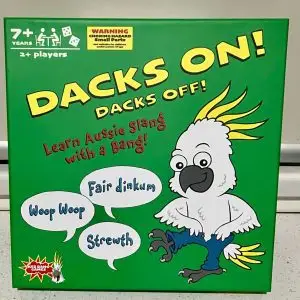
If you’re looking for a practical way to Learn Australian slang, Dacks On offers engaging learning experiences designed around authentic Australian English. Through interactive games, quizzes, and cultural learning, you can build your vocabulary while becoming more comfortable with everyday conversations you’ll hear across Melbourne and the rest of Australia.
Whether you’re preparing for university, starting a new job, travelling, or simply wanting to connect with locals more naturally, practising a little each day can make a noticeable difference.
Frequently Asked Questions
What are the best Games with Aussie slang for beginners?
Simple matching games, bingo, flashcards, and conversation role-plays are excellent starting points because they introduce vocabulary in context without overwhelming learners.
Can adults learn Australian slang through games?
Absolutely. Interactive learning works well for adults because it encourages active participation, repetition, and real-life communication rather than passive memorisation.
Are Aussie slang game activities suitable for classrooms?
Yes. Many schools, universities, and English language programs use quizzes, role-playing, and team challenges to help students practise conversational English.
Is Melbourne slang different from other parts of Australia?
Most Australian slang is understood nationwide, although some regional expressions and pronunciation differences exist. Melbourne’s multicultural environment also influences everyday language.
How long does it take to become comfortable using Australian slang?
It depends on your exposure and practice. Learners who regularly listen to Australians, join conversations, and play interactive language games often build confidence much faster than those relying only on vocabulary lists.
Why should I learn slang if I already speak English?
Understanding slang helps you follow everyday conversations, build stronger relationships, and feel more confident in social situations. It’s an important part of communicating naturally in Australia.
Final Thoughts
Learning Australian English isn’t about memorising hundreds of unfamiliar expressions. It’s about understanding how people communicate in everyday life and feeling comfortable joining those conversations.
That’s why Games with Aussie slang are such an effective learning tool. They transform vocabulary into practical communication, helping learners remember words through experience rather than repetition alone.
Whether you’re exploring Melbourne, beginning university, relocating for work, or travelling across Australia, interactive learning makes it easier to recognise local expressions, respond naturally, and enjoy authentic conversations.
Start with a few simple games, practise consistently, and don’t be afraid to make mistakes. Every conversation is another opportunity to build confidence—and every new expression brings you one step closer to speaking Australian English naturally.